Blog & Recipes

From our kitchen to yours.

Recipes you can actually make, nutrition tips that make sense, and the story behind how we keep it clean.

Why your brain craves junk food

Why Your Brain Tricks You Into Ordering Junk After a Long Day at Work

It's 8 PM. You're exhausted. Your brain wants cheese, sugar, and grease — not a salad. Here's the neuroscience of why that happens, and what you can actually do about it.

Read article →
Gurgaon food trends 2026

What Gurgaon Is Actually Eating in 2026 — And What's Changing

Protein-first menus, preservative-free labels, and the death of the sad desk lunch. A founder's look at how corporate Gurgaon's food habits are shifting.

Read article →
Why cheese satisfies your brain

Why Cheese Satisfies Your Brain More Than Your Stomach — The Science of Comfort Food

Cheese contains casomorphins — compounds that bind to the same brain receptors as opioids. Here's why a cheesy wrap after a hard day feels like a hug from the inside.

Read article →
No freezer in our kitchen

We Don't Own a Freezer. Here's Why That Nearly Killed Our Business — And Why We'd Do It Again.

Every kitchen in food delivery has a freezer. We threw ours out. Fresh food under 12 minutes, no frozen inventory, no safety net. The hardest decision we ever made.

Read article →
← Back to all posts
Why your brain craves junk food
Nutrition

Why Your Brain Tricks You Into Ordering Junk After a Long Day at Work

By Vidit Sinha, Co-Founder, Happy Ratio · April 8, 2026 · 7 min read

It's 8:30 PM on a Wednesday. You just got out of a three-hour review that went sideways. You haven't eaten since that chai and biscuit at 4 PM. You open Zomato. Your thumb hovers over the butter chicken. The loaded fries. The double-cheese pizza.

You know the wrap or the salad would be better. You know it intellectually. But your brain isn't interested in intellectual arguments right now. It wants relief. It wants dopamine. It wants fat, sugar, salt — and it wants it in 25 minutes.

I run a food business in Gurgaon. I see this pattern every single day in our order data. Our healthiest items sell like crazy between 12 PM and 2 PM. By 8 PM, the heaviest, most indulgent wraps dominate. The same people, the same area — but a completely different brain state.

Here's what's actually happening inside your head.

The cortisol-dopamine loop

When you're under sustained stress — back-to-back meetings, tight deadlines, difficult stakeholders — your body floods with cortisol. Cortisol is a survival hormone. It doesn't care about your fitness goals. Its job is to keep you alive, and it does that by screaming for high-calorie, fast-absorbing energy.

Cortisol simultaneously does two things that sabotage your evening food choices. First, it ramps up your appetite — specifically for foods high in sugar, fat, and salt. Second, it reduces activity in your prefrontal cortex, the part of your brain responsible for impulse control and long-term decision-making.

So you're hungrier, you crave the worst possible options, and the part of your brain that would normally say "maybe order something lighter" is running on fumes. The game is rigged before you even open the delivery app.

Why cheese and carbs feel like therapy

Here's the thing nobody tells you: your craving for a cheesy, carb-heavy meal after a stressful day isn't weakness. It's neurochemistry.

When you eat foods high in carbohydrates, your body produces more serotonin — the neurotransmitter that regulates mood. That's why pasta, bread, and rice feel soothing. Your brain is literally self-medicating its depleted serotonin reserves.

Fat works differently — it triggers dopamine, the reward chemical. Sugary, fatty foods provide a rapid dopamine spike that your stressed, depleted brain interprets as: "Finally, something good happened today."

The combination of fat + salt + carbs is essentially a neurochemical triple hit. Your brain gets serotonin (mood lift), dopamine (pleasure), and a blood sugar spike (instant energy). For about 20 minutes, you genuinely feel better. Then comes the crash, the bloat, and the 3 AM regret.

The real problem: your brain remembers

The most insidious part isn't the single bad meal. It's the habit loop. Every time stress leads to junk food and junk food leads to temporary relief, your brain strengthens that neural pathway. Stress → junk food → relief becomes automatic. Your brain stops asking you — it just drives you to the cupboard, or the delivery app, without conscious deliberation.

Researchers at Harvard have found that this pathway is identical to the one activated by addictive substances. The dopamine reward system doesn't distinguish between a line of cocaine and a plate of loaded nachos. The magnitude is different, but the mechanism is the same.

What actually works (from someone who feeds stressed people for a living)

I'm not going to tell you to eat raw vegetables at 9 PM. That's unrealistic and honestly disrespectful to how exhausted you are.

What works is giving your brain what it wants — dopamine, satisfaction, a feeling of reward — without the inflammatory crash that follows ultra-processed food. Here's what I've learned from two years of feeding corporate Gurgaon:

Eat before the cortisol wins. The biggest predictor of junk food ordering at night isn't how stressful your day was — it's how long since your last real meal. If you eat a proper lunch at 1 PM and nothing until 8:30 PM, cortisol has seven hours to build an unbeatable craving. A 5 PM snack — even something small — breaks the cycle.

Choose "comfort food adjacent." Your brain doesn't actually need pizza. It needs fat, salt, and texture. A well-made wrap with real cheese, fresh vegetables, and homemade sauce provides the same dopamine triggers — fat, salt, crunch — without the inflammatory load of ultra-processed food. That's literally why we built our menu the way we did.

Don't fight the craving. Redirect it. Willpower is a depleting resource and by 8 PM on a hard day, yours is at zero. Instead of resisting, pre-decide. Have your go-to healthy-enough order saved on Zomato. Don't browse. Don't compare. Just tap.

Your brain doesn't want junk food. It wants relief. The question is whether you give it relief that costs you the next 12 hours, or relief that actually leaves you feeling good.

Next time you're sitting on your couch at 9 PM, thumb hovering over the butter chicken, just know: it's not you. It's cortisol, dopamine, and a prefrontal cortex that checked out two hours ago. And knowing that is half the battle.

Craving something satisfying that won't wreck your morning?

Our wraps were built for exactly this moment.

← Back to all posts
Gurgaon food trends 2026
Trends

What Gurgaon Is Actually Eating in 2026 — And What's Changing

By Vidit Sinha, Co-Founder, Happy Ratio · April 5, 2026 · 6 min read

I've spent the last two years running a food business inside Gurgaon's corporate ecosystem — first at DLF Cyber Hub, now at Udyog Vihar. I see every order, every repeat customer, every pattern. And what I'm seeing in 2026 is a shift that nobody's really talking about yet.

Gurgaon's relationship with food delivery is changing. Not in the dramatic "everyone went vegan" way that trend reports love to predict. More quietly. More practically. In the choices people make at 1 PM on a Tuesday when they're hungry and have 15 minutes.

The "protein-first" shift is real

This is the biggest change I've seen in the last 12 months. Gurgaon's corporate professionals — especially the 25-35 demographic — are actively looking at protein content before they order. Not all of them. Maybe 30%. But that 30% is vocal, consistent, and growing fast.

India's online food delivery market is valued at over ₹5 lakh crore and NCR leads the country — accounting for roughly 30% of all online food orders. The Delhi-Gurgaon-Noida corridor alone concentrates millions of young professionals with disposable income and digital-first consumption habits. And these consumers are getting smarter about what they eat.

At Happy Ratio, our protein smoothies now account for nearly 25% of revenue. A year ago, that number was closer to 10%. People aren't just ordering wraps — they're asking "how much protein is in the Soy Keema Paneer?" before they order. That question simply didn't exist in 2024.

The preservative backlash is building

Here's something I didn't expect: people are starting to read ingredient labels on delivery food. Not all of them — but enough to matter. The global trend toward "clean labels" and ingredient transparency has reached Gurgaon, and it's showing up in customer conversations.

When we launched Happy Ratio, "zero preservatives" was our core promise. Back then, most customers nodded politely but ordered based on taste and price. Now, it's genuinely a selling point. Customers DM us on Instagram asking if our spreads are homemade. They want to know if the tortilla has maida or whole wheat. This level of scrutiny didn't exist two years ago.

Whole Foods' 2026 trend report highlights "fiber-forward" foods and functional ingredients as the year's biggest movements globally. In Gurgaon, we're seeing the Indian version of this: people want food that's real, recognisable, and made from scratch. Not "healthy" in the bland, joyless way — but clean in a way they can trust.

The death of the sad desk lunch

The most interesting trend isn't about health at all. It's about dignity.

Gurgaon's corporate crowd is rejecting the idea that lunch should be an afterthought — a soggy sandwich from the canteen, a bland meal box from a catering contract. People are treating lunch as a daily moment of choice and self-care. They're willing to spend ₹50-100 more for food that feels intentional, not industrial.

Our order data shows lunch accounts for over 55% of all orders, and it's growing. But the average order value at lunch has gone up 18% year-on-year. People aren't ordering more food — they're ordering better food. That's not a trend. That's a cultural shift.

What's coming next

Customisation. Gurgaon's food consumers want control. Build-your-own bowls, choose-your-protein wraps, custom smoothie combos. We've seen this in our Wrap Box orders — teams ordering 5-7 different wraps rather than one standard option. The era of "one curry for 40 people" corporate catering is ending.

Evening delivery is the next battleground. Right now, most healthy food brands focus on lunch. But the 7-9 PM window is where the real volume is, and it's dominated by pizza and biryani. The brand that figures out how to make healthy food feel like an indulgent evening meal — not a compromise — will win this slot. That's exactly what we're building toward.

Transparency becomes table stakes. Within two years, I believe "made fresh" and "no preservatives" will be as expected on Gurgaon food menus as "free delivery" is today. The brands that can't prove their ingredient quality will lose to those that can.

Gurgaon doesn't need another restaurant. It needs food that respects both the taste buds and the body. That's the gap we built Happy Ratio to fill.

Taste the shift yourself

Fresh wraps, real ingredients, delivered to Udyog Vihar and surroundings.

← Back to all posts
Why cheese satisfies your brain
Nutrition

Why Cheese Satisfies Your Brain More Than Your Stomach — The Science of Comfort Food

By Vidit Sinha, Co-Founder, Happy Ratio · March 30, 2026 · 6 min read

Let me tell you about a pattern I noticed in our order data that genuinely surprised me.

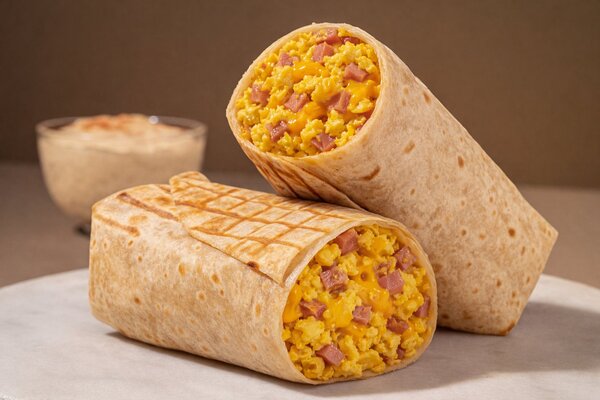
Our Egg, Ham & Cheese wrap outsells every other non-vegetarian item by a factor of 2x. It's not the most Instagram-worthy wrap on our menu. It's not the spiciest. It's not the most "healthy-looking." But customers order it repeatedly — some of them three, four times a week.

When I started digging into why, I fell down a rabbit hole of neuroscience that changed how I think about food, comfort, and what our brains actually need at the end of a hard day.

Cheese is low-key hijacking your reward system

Here's something most people don't know: cheese contains a protein called casein. When your body digests casein, it breaks down into compounds called casomorphins. And casomorphins bind to the exact same opioid receptors in your brain that morphine does.

Now, before you panic — the effect is dramatically milder. Researchers estimate casomorphins are roughly 20 times less potent than actual morphine. But the mechanism is identical: casomorphins trigger dopamine release in your brain's reward centres, producing feelings of pleasure, relaxation, and satisfaction.

This is why cheese feels like more than just food. When you eat a cheesy wrap or a slice of pizza after a brutal day, the satisfaction you feel isn't just about flavour. Your brain is receiving a genuine neurochemical reward — a mild opioid hit that temporarily calms your stress response.

A University of Michigan study found that pizza — largely because of its cheese content — topped the list of foods people found hardest to stop eating. It wasn't the dough. It wasn't the sauce. It was the cheese.

Why this matters at 8 PM on a weeknight

Connect this back to the cortisol problem. After a stressful day, your brain is depleted of dopamine and serotonin. It's actively searching for anything that will restore those levels. Cheese provides exactly that — a concentrated dose of casomorphins that trigger dopamine, plus high fat content that independently activates the brain's reward pathways.

But cheese also does something else: it contains phenylethylamine, an amino acid that your body converts into a stimulant compound with a chemical structure similar to amphetamines. And it contains tyrosine, another amino acid that directly boosts dopamine and adrenaline levels while also improving sleep quality and cognition.

So when someone says "I just need some cheesy comfort food" — they're being more scientifically accurate than they realise. Their brain genuinely needs what cheese provides: a cocktail of compounds that simultaneously soothe the stress response, boost mood, and deliver a feeling of warm satisfaction.

The evolutionary backstory

There's actually an evolutionary logic here that I find fascinating. Casomorphins in milk likely evolved to strengthen the bond between mother and infant — the mild opioid effect encourages newborns to keep nursing. When we concentrate milk into cheese (it takes about 10 litres of milk to make 1 kg of cheese), we're concentrating those casomorphins too.

Our attraction to cheese may be hardwired from birth. It's not a modern vice — it's an ancient survival mechanism that helped mammals thrive. The problem arises only when we pair that ancient craving with modern ultra-processed food: cheese on a base of refined flour, with artificial flavours, preservatives, and excess sodium.

How to work with your brain, not against it

Here's what I took away from all this research — and why it directly shaped our menu at Happy Ratio:

Don't deny the cheese craving. Your brain has legitimate neurochemical reasons for wanting it. Denying it entirely leads to binge-eating it later. Instead, have cheese in a context that doesn't come loaded with processed garbage. Real cheese in a fresh wrap with vegetables is a fundamentally different experience for your body than processed cheese on a frozen pizza.

Pair it with protein and fibre. The crash from cheese-heavy junk food comes not from the cheese itself, but from the refined carbs and lack of fibre around it. Our Egg, Ham & Cheese wrap works because the protein and fresh vegetables slow the blood sugar response and extend the satisfaction window.

Understand what you're actually craving. Often, the craving for "cheese" is really a craving for comfort, warmth, and neurochemical relief. Exercise, social connection, and sleep all boost the same neurotransmitters. But on the nights when none of those are accessible, a well-made cheesy wrap is a genuinely reasonable option.

Comfort food isn't the enemy. Ultra-processed comfort food is. The goal isn't to eliminate pleasure from eating — it's to find pleasure in food that doesn't punish you the next morning.

That's the philosophy behind everything we make at Happy Ratio. We don't ask you to choose between food that tastes good and food that is good. That's a false choice, and your brain — with all its casomorphin receptors and dopamine pathways — deserves better than that.

The Egg, Ham & Cheese is waiting

Your brain's favourite wrap. Made with real ingredients, no preservatives.

← Back to all posts
No freezer in our kitchen
Our Story

We Don't Own a Freezer. Here's Why That Nearly Killed Our Business — And Why We'd Do It Again.

By Vidit Sinha, Co-Founder, Happy Ratio · April 9, 2026 · 8 min read

When we tell people in the food industry that we don't have a freezer in our kitchen, they look at us like we told them we cook without fire.

"No freezer? How do you store your ingredients?"

"We don't."

"What about backup stock? What if you get a rush of 40 orders?"

"We prep fresh. Every day. Every order."

The silence that follows is usually a mix of confusion and pity. Because in the food delivery business, a freezer isn't a convenience — it's a survival tool. Every cloud kitchen in Gurgaon runs on frozen inventory. Pre-made sauces in freezer bags. Marinated proteins stored for days. Base gravies frozen in batches. It's how you scale. It's how you survive the 1 PM lunch rush without losing your mind.

We threw all of that out. And I'm not going to pretend it was easy.

Why we made this decision

When Harsh and I started Happy Ratio, we had one non-negotiable: the food had to be genuinely fresh. Not "fresh" in the marketing sense where everything gets called fresh. Actually fresh. Made from raw ingredients that morning, assembled when you order, served within minutes of being cooked.

The problem is, that promise is almost impossible to keep in the food delivery model. Delivery platforms reward speed. Zomato's algorithm penalises you if your Kitchen Preparation Time (KPT) goes above 20 minutes. Customers expect their order in 30 minutes or less. In that window, you need to receive the order, prep the ingredients, cook, assemble, package, and hand it to the delivery partner.

A freezer solves this equation elegantly. Pre-make everything. Freeze it. Reheat when the order comes in. Your KPT drops to 8 minutes. The platform loves you. The customer gets their food fast. Everyone's happy.

Except the food tastes like it was pre-made. Because it was.

The SOP that makes it work

If you're going to promise fresh food without a freezer, you need SOPs that are almost militarily precise. Here's what we built:

Morning prep window (9:00 - 11:00 AM): Every spread, every sauce, every chopped vegetable is prepared fresh. Hummus, tzatziki, green chutney, chipotle mayo — all made from scratch that morning. Vegetables are washed, cut, and portioned into containers. Proteins are marinated. Nothing from yesterday carries over.

The 12-minute promise: From the moment an order hits our system to the moment it's packaged and ready for pickup — 12 minutes maximum. We've timed it. We've broken it down second by second. Here's how it works:

⏱ The 12-Minute SOP

0:00 - 0:30: Order received. Kitchen display shows the wrap type, any customisations.
0:30 - 2:00: Tortilla goes on the grill. Filling ingredients are pulled from the day's prep station.
2:00 - 5:00: Protein or filling cooked/heated. Sauces portioned. This is the only step that involves actual cooking — and because we're working with small portions and high heat, it's fast.
5:00 - 7:00: Assembly. Tortilla off the grill, sauce spread, filling added, fresh vegetables layered, wrap rolled and pressed.
7:00 - 9:00: Wrap cut, inspected, wrapped in foil and branded paper.
9:00 - 12:00: Packaged into delivery bag. Order tagged. Ready for pickup.

Twelve minutes. No freezer. No reheating. No microwave. The wrap that arrives at your door was literally raw ingredients 12 minutes before the delivery partner picked it up.

What nearly broke us

I'll be honest — the first three months were brutal.

Waste was horrifying. Without a freezer, anything we prepped in the morning that didn't sell by evening was gone. We couldn't freeze it for tomorrow. We couldn't repurpose it. It went in the bin. In our early weeks, we were throwing away 20-30% of our morning prep. That's real money — ingredients, labour, time — straight into the garbage.

Rush hours exposed every weakness. At 1 PM, when 15 orders hit simultaneously, a freezer kitchen just reheats and ships. We had to actually cook 15 wraps from scratch in real time. Our KPT spiked to 22-25 minutes. Zomato's algorithm pushed us down in search rankings. Orders dropped further. It was a vicious cycle.

Nobody believed us. When we told customers "everything is made fresh, we don't have a freezer," they nodded politely and assumed we were lying. Because every food brand says "fresh." The word has been so diluted by marketing that it means nothing anymore. We had no way to prove it except through the food itself.

How we solved it

Demand forecasting. After three months of data, we built a simple forecasting system. Monday through Friday, we know roughly how many orders to expect per hour, per day. We prep for that number plus a 15% buffer. Our waste dropped from 30% to under 8%. That's still higher than a freezer kitchen (which wastes almost nothing because everything's frozen), but it's sustainable.

Smaller, faster batches. Instead of one big morning prep, we do two. A main prep at 9 AM for the lunch rush, and a smaller "top-up" prep at 3 PM for evening orders. This means our evening wraps are made with ingredients that were prepped 2-3 hours ago, not 8 hours ago.

We got faster. Practice. Repetition. Muscle memory. Our kitchen team can now do what took 18 minutes in month one in under 11 minutes today. Our current average KPT on Zomato is 15-17 minutes — competitive with freezer kitchens, but with food that's incomparably fresher.

The food proved it for us. This is the part I'm most proud of. We never ran a marketing campaign about "no freezer" or "made fresh." We didn't need to. Customers tasted the difference. Our repeat rate climbed. Our ratings stabilised above 4.0. People started leaving reviews saying things like "this actually tastes homemade" and "you can tell it's not sitting around pre-made." The food did the marketing.

What "no freezer" really means

It means we can't scale the lazy way. We can't batch-cook 200 portions of soy keema on Monday and serve it all week. We can't buy frozen vegetables in bulk and pretend they're fresh. We can't make sauces once a month and keep them in cold storage.

Every single day, our kitchen starts from zero. The same vegetables get cut. The same spreads get made. The same proteins get prepped. It's Groundhog Day, and that's the point. Because when you eat a Happy Ratio wrap on Friday, it should taste exactly as good as the one you had on Monday — because it was made with the same care, the same process, and ingredients that are equally fresh.

A freezer isn't just a machine. It's a philosophy. It says "good enough today is good enough tomorrow." We decided that wasn't good enough for us. And once we proved it could work, it became the thing that makes us different from every other delivery kitchen in Gurgaon.

Do I recommend this approach to other food entrepreneurs? Honestly, no — not unless you're willing to eat the waste costs, build insanely tight SOPs, and accept that your first few months will be painful. But if you're the kind of person who tastes the difference between fresh tzatziki and the stuff that's been sitting in a fridge for three days, then you already understand why we did it.

We don't own a freezer. And at this point, we never will.

Taste what fresh actually means

Every wrap made from scratch, in under 12 minutes, with zero frozen ingredients.